Addicted by Design
The Illusion of Control

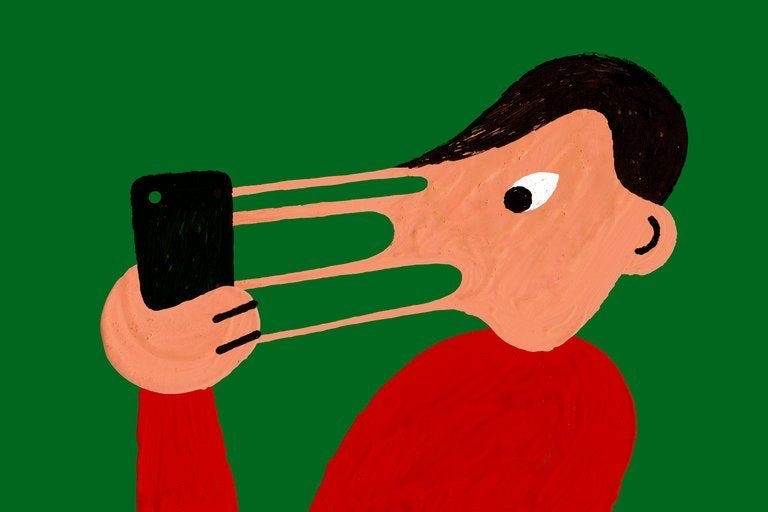
Do we control our phones, or do they control us? Like most people, I’m addicted.
Before bed, I watch video essays; when I wake up, I check notifications.
During the day, I am constantly hyper-conscious of where my phone is. I instantly imagine that I’ve left it in silent study and my phone is blasting CMAT.
If I don’t know where it is (like my vape) I enter a state of utter panic, thinking of all the potential scenarios.
I know it’s bad for me, I shouldn’t be so tied to a tiny wee device.
But I am.
And I think that I do have a somewhat healthy-ish relationship with my phone. I banish it to another room when I am studying or reading.
Not out of great passion but to escape its grip.
As a philosophy student, my special topic is the relationship between man and his technologies; is it simply a tool we use to enhance our lives or am I dominated by it?
A recent essay I just handed in was about whether Tech has replaced God, where I argued that the worship of tech doesn’t qualify as an organised religious practice but that within culture we do subtly submit to our devices.
I do believe that technology orders us, and has thus dehumanised us. Our existence fundamentally relies on it to a point where there would be a mass existential crisis if they were all to disappear.
Ultimately, the question isn’t whether we control our phones or they control us.
It’s how we navigate a world were opting out feels impossible.
Big Tech has engineered these devices to be addictive, and our culture reinforces that dependency.
They built the trap and we walked in. But I’m learning that control isn’t a switch, but a habit built over time.
Every time I put my phone down, every time I choose presence over pings, I take back a wee bit of power. Maybe that’s the best we can do: not escape, but negotiate.
And yes, I feel like my Mum. Whenever I was in a foul mood at fifteen, she would say:
“ITS THAT BLOODY PHONE!”
(which looking back it probably was, I just didn’t want to hear it)
‘Phones are bad’ is the easiest sermon to preach (usually from a phone).
But they’re not villains, they’re just irresistible.
The solution? Not obliterating them with hammers (tempting though). It’s just about setting boundaries.
In 2026, rebellion isn’t deleting Instagram or having the privilege of getting a Nokia brick and disconnecting (as a journalist I physically cannot do that).
It’s turning off notifications and feeling like a 16th century recluse.